Margin of Σrror

Margin of Σrror -

If the US held a referendum today, gay marriage would win | Harry J Enten

Even allowing for polling overestimating support for same-sex marriage, a majority of Americans would now vote for equality

Much hangs on how the nine US supreme court justices rule later this year on the two same-sex marriage cases they’ve heard this week, but if given the chance would Americans vote in favor of marriage equality?

Would they have done so last year, or, more importantly, today? I think the answer to all those questions is likely yes – but that differs from Nate Silver’s more equivocal judgment and what Chris Stirewalt believes.

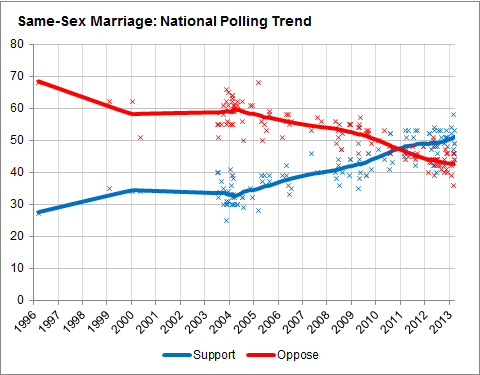
Let’s start with the fact that the aggregate of all the same-sex marriage polling had support from about 50% of the population and opposition from 43% in 2012. Since then, we’ve seen about 1-2pt increase in the percentage favoring marriage. So, in order to believe that gay marriage wouldn’t pass a nationwide referendum, you’d have to think that this polling data is unrepresentative of an election’s results.

One reason you might believe that is because actual voters tend to be more conservative than adults at large. That’s why Obama was winning handily among all adults, but was in a tight race with Romney among likely voters. Is this gap apparent with regard to same-sex marriage? As it turns out, not really.

On the eve of the 2012 election, Pew saw a minimal difference between how adults as a whole and likely voters viewed same-sex marriage. All adults were in favor of same-sex marriage, 49% to 40%, while likely voters were in favor by 49% to 42%.

The other argument against these national polls posits some sort of “gay Bradley effect“. That is, polls for same-sex marriage state ballot measures have had a tendency to underestimate voters who wanted to ban same-sex marriage. Some, like Stirewalt, argue that a social desirability bias makes people not want to admit voting against perceived civil rights.

Either way, Patrick Egan found that the anti-gay marriage side (pdf) did 7pt better than polls suggested, while the pro-gay marriage side did about as well. California’s Prop 8, for instance, trailed in the polls before passing.

When I ran my own data back in 2009, however, it was fairly clear that the “gay Bradley effect” was lessening over time. Polls taken closer to 2009 were more accurate than ones taken further back.

Since 2009, there have been five same-sex marriage ballots with polling conducted within 10 days of the election. The 10 days are key because ballot wording can be very confusing, and voters only really tune into campaigns in the final weeks. Gregory Lewis and Charles Gossett showed that confusing ballot wording is a likely part of the reason why polling on Prop 8 was inaccurate.

When we look at the ballot measures polls taken within 10 days of the elections, from 2009 onward, the pro same-sex marriage side didn’t suffer anywhere close to the 7pt penalty that Egan had discovered. Maine’s 2009 Question 1 had one poll taken within 10 days of the election. Public Policy Polling (pdf) (PPP) had voters “vetoing” same-sex marriage by a 4pt margin, and it was vetoed by a 6pt margin. That’s only a difference of 2pt, not 7pt.

North Carolina’s May 2012 Amendment 1 had two polls taken within 10 days of the election. An average of PPP’s and SurveyUSA’s polls, with undecideds allocated proportionally to decided voters, had North Carolinians banning gay marriage by a 19pt margin. They ended up banning it by a 22pt margin, a difference of 3pt.

Maine’s November 2012 Question 1 had three polls taken within 10 days of the election. The median result of the polls from Critical Insights, Maine’s People Resource Center and PPP had voters approving of same-sex marriage by 7.2pt. It passed by 5.4pt. A difference of a little less than 2pt.

Minnesota’s Amendment 1 had three polls taken within 10 days of the election. The median result of two SurveyUSA polls and PPP’s survey, which allocated undecideds, had the amendment to ban same-sex marriage failing by 1pt. The actual voters were against the amendment by 3.8pt. In this case, the polls overstated those favoring the ban by about 3pt.

Finally, Washington’s Referendum 74 had two relevant polls. The average result of the PPP and SurveyUSA, with undecideds allocated, had same-sex marriage passing by 10pt. It passed by 7.4pt, for a difference of 2.6pt.

In four of the five instances, the opposition to the same-sex marriage side did better than polling predicted – but that difference was not particularly significant; certainly not of the order of 7pt, as previously found. The largest difference was just 3pt, and the median error in margin was only 2pt.

Applying this 2pt penalty to the 7pt edge that the pro-same-sex marriage crowd had over the opposition in 2012 national polling still gives the pro side a 5pt edge. If we apply an additional 2pt penalty (see Pew above), because most national polls question adults, and not likely voters, the pro same-sex marriage side still had a 3pt edge going into the 2012 election. Already, now, that lead would be closer to 4-5pt.

We can check my work by looking at the 2012 national exit polls. These polls are weighted to the actual results of the November elections. Voters cast their ballots anonymously, away from any interviewers, and drop their ballots in a box. There’s no reason to think voters would fear giving an “undesirable” answer, as nobody’s around to judge.

The exit poll asked: “Should your state legally recognize same-sex marriage?” “Yes” beat “no” by the exact 3pt that our adjustment of national surveys would suggest. The fact that the exit polls and national polls matched up makes me even more confident in the finding.

So, yes, I think Americans would have voted in favor of same-sex marriage, had they been given the opportunity in 2012-13. The national polls may be overstating support right now, but any error is not enough to erase the majority in favor of gay marriage.

In the end, though, I don’t think there’s much disagreement about the road going forward. Same-sex marriage support is increasing every day. A national same-sex marriage ballot measure would likely win by a huge margin in 2016. The tide has turned. It’s tough to imagine it receding.

guardian.co.uk © 2013 Guardian News and Media Limited or its affiliated companies. All rights reserved. | Use of this content is subject to our Terms & Conditions | More Feeds

Americans want gun control, but not badly enough | Harry J Enten

Gun rights advocates know that, despite Newtown, the US public is only lukewarm about gun laws – and is cooling all the time

After a month of reported congressional movement on gun control, negotiations have apparently hit a snag. Democratic senators have decided to break up proposals into different packages – such as Senator Dianne Feinstein’s push for an assault weapons ban – instead of presenting one “Obama gun package”. And, unsurprisingly, Republicans and Democrats can’t seem to agree on what parts should make up a background check bill.

On the surface, this seems like Washington dysfunction at its worst, especially since the percentage of Americans who want tougher gun control has stayed at its post-Newtown high: a majority still wants a ban on assault weapons, although legislation on that has pretty nearly no chance of passing through Congress. Over 80% of Americans do agree on universal background checks, including a majority of Republicans.

But a deeper look at the numbers suggests that gun rights advocates may be playing a stronger hand than at first glance.

1. Most Americans don’t see gun control as the most significant way to prevent mass shootings

Per a Public Religion Research Institute poll, only 25% of Americans believe that stricter gun control laws and enforcement would be the key to preventing massacres. That was second to mental health screenings, at 30%, and just ahead of moral and religious teaching, at 20%.

Even when we expand the issue out to allow for multiple answers, as CBS News did, only 21% think that stricter gun control would prevent gun violence by much. Almost half, 46%, think mental health screening would help a lot, while 36% think armed guards in public places would be most useful.

2. Guns as a whole are not at the forefront of issues for most Americans

Only 4% of Americans listed guns as the most important problem facing the country in the latest CBS News poll. Instead, over 50% chose the economy, jobs or the budget deficit. That matches other recent polling, and the recent focus on the sequestration illustrates this data.

You might say, “Of course, the economy is the No 1 issue for Americans – how could gun control come close?” And I’d agree: if gun control were really at the top of the heap, I’d expect it to be polling higher. During the healthcare debate of 2009-10, for instance, healthcare regularly broke the 20% barrier in polls on the most important issue in the US.

Now, it’s possible for Americans to care about more than one issue at once, but it’s fairly clear that gun control can get lost in our current mess of unemployment, budget cuts, and a stalling legislature. But gun control tends to be tied with healthcare and immigration as the most important issue, at all of 5%. Right now, healthcare isn’t even a national issue so much as a state one, in parts of the country.

3. Most Americans don’t feel gun legislation needs to be passed this year

This doesn’t come as a shocker given my last point, yet gun rights advocates have to like this number: only 46% of Americans in the latest Pew Research poll believe it is essential to pass gun legislation this year. That number includes only 42% of independents, and in fact, only 71% of Democrats who think that gun safety legislation is essential this year.

This is a key point because Republicans might fear being seen, once again, as “too rigid” and the “party of no”, as many Americans feel they are. But they can rest a little easier when it comes to guns. The American public seems to be saying that there’s nothing wrong with a delay.

4. Public opinion on gun control will eventually run out

If new gun laws aren’t passed this year, then they likely won’t be passed at all. Past history indicates that the current tide of opinion in favor of gun control will ebb over the course of the year. After Columbine, the only event in recent history with a comparable increase in favor of gun control, the high-water mark dropped after a year.

The reasons are twofold. First, the movement in favor of gun control has been driven mostly by media coverage. The media has yet to abandon stories about gun control, but time and a business imperative will eventually take their toll. Newer and more compelling news stories will fill the headlines, and most people will follow where the news coverage leads.

Second, the general movement over the past two decades has been against greater gun control. Take a look at the image above and take away the Sandy Hook spike. Prior to the Newtown shooting, the percentage of Americans in favor of stricter gun control had dropped below 50% – the first time that had ever happened.

Thus, from a game theory standpoint, I’m not exactly sure congressional members who want minimal gun control should rush into any deal. They have the numbers to stop any gun control measures in the Senate by filibuster, and they have a majority in the House. As importantly, if they look at the polling, they’ll know that they won’t face much of a penalty from the public: America isn’t exactly clamoring for tighter gun control and believes that other steps would do more to curb gun violence.

This is not to say a bill on background checks won’t pass through Congress. It’s just that the current hold-up should surprise no one; and despite the weight of current opinion, the pressure to make a law on guns probably won’t increase.

guardian.co.uk © 2013 Guardian News and Media Limited or its affiliated companies. All rights reserved. | Use of this content is subject to our Terms & Conditions | More Feeds

How far can President Obama go with an executive order on gun control? | Harry J Enten

Since any gun safety law would face opposition in a Republican-controlled Congress, the president must weigh public opinion

Vice-President Joe Biden’s gun panel is set to report to President Barack Obama next Tuesday. The common view is that any legislation that is at all controversial would have a difficult time getting passed by the Republican-controlled House of Representatives. Now, Biden has raised the possibility of getting gun control measures by executive order.

My advice for the president as someone who reads polls: go for it, if it’s what you want to do. There is much discussion that acting by executive order would be seen as a “totalitarian” action and provoke a backlash. Nonsense, so long as the order is supporting a measure the public favors.

Consider that in June 2012 Obama took executive action on a “mini-Dream Act” that provided a path to avoid deportation for some undocumented immigrants who came to the country before the age of 16, had a high school education (or were attending school) or had served in the military, and had no criminal background. He did so administratively because he couldn’t get a law passed by Congress.

There was heavy public support before the order was signed. Back in late 2010, Gallup found that 54% of Americans would vote for a bill that would allow for undocumented immigrants who were brought to the country in their youth to have a pathway to citizenship. A late 2011, a Fox Poll put support for such a law at 63%.

After Obama made the new policy instruction, the public held to its position. Five polls taken between the June announcement and now found that anywhere from 54% to 64% of Americans still believe that young undocumented immigrants should not be sent packing. This includes three questions that specifically mentioned Obama’s name, and that his administration had “announced” the policy change (in other words, the measure specifically didn’t pass through Congress).

You might argue that the gun debate is different because the powerful gun rights lobby would be able to convince the public otherwise. The flaw in that statement is that the National Rifle Association (NRA) is just not that popular these days: only 42% of Americans have a favorable view of the NRA per Public Policy Polling, which is down from 48% just a few weeks ago.

The president is also dealing with a public that’s seen its support for gun control climb higher since the Sandy Hook school shooting in Newtown, Connecticut. I count five pollsters (ABC/Washington Post, CBS News, Gallup, CNN/ORC, and YouGov) that asked a question about whether gun control should be stricter before and after Newtown. Before the massacre, the weaker “stay the same” position on gun control beat the stricter position by an average of 3.8 percentage points. Afterward, stricter led by 11.4pt – a 15.2pt turn-around.

Past history suggests that the president can’t wait around until he gets a Congress that is willing to cooperate. After the Columbine shooting in 1999, Americans’ support for stricter gun laws jumped by 5-10pt. After a year or two, the spike had abated and appetite for stricter gun laws continued its slow decline to the minority position it held just before Newtown.

So what policies should the president consider, as long as he thinks courts will uphold his orders?

• He should end the “gun show loophole” to force people who buy guns at a gun show or through private sales and online shopping to have a background check: 92% of Americans favor this position per Gallup, while PPP puts support at 76%.

• Obama should seek to ban high-capacity ammunition clips that contain more than 10 bullets: CNN/ORC, Gallup, Pew, PPP, and YouGov all show at least 53% of Americans in favor of this policy.

• He should seek ways to ensure that people with poor mental health records do not get a gun: CNN/ORC found that 92% Americans did not want Americans with mental health problems to be in possession of a gun; PPP took it one step farther and discovered that 63% of Americans want people to be required to take a health exam before buying a gun.

• Obama should obviously prevent felons convicted of a violent crime from owning a gun: 94% and 92% approve of that measure, per PPP and CNN/ORC respectively.

• He should try to make sure that guns, even if not recently purchased, would be registered with a government or law enforcement agency: CNN/ORC finds 78% agree with that policy.

• Obama should look to ban outright bullets that explode or are designed to break through a bullet-proof vest: Pew found that 56% favor this position.

• Obama should try to make it more difficult to buy ammunition and/or guns over the internet: 69% of Americans wanted to ban these practices, according to PPP.

You’ll note I don’t include an assault weapons ban. The reason is that pollsters are split: Gallup and Pew signal that a majority is opposed to banning assault or semi-automatic weapons, while ABC/Washington Post, CNN/ORC, PPP, and YouGov show the reverse. It seems to me that, politically speaking, an executive order would be the wrong course on an issue that apparently splits the country down the middle.

Further, the president would almost certainly be better-off passing any law through Congress. It not only looks better, but it lessens the chance of any political blowback I may be underestimating. The danger, of course, is that if a bill fails to get through Congress, it would look like awfully sour grapes then to obtain gun control measures through executive orders. It’s quite possible that the public would see that as executive over-reach.

Also, I am by no means a constitutional scholar: while there are plenty of people arguing in favor of executive action, others argue that some of these proposals, if put into action by executive order, would be unconstitutional and would be ruled so.

That said, if the president is sensitive to public opinion and reading the polls, there are a number of gun control policies he can obtain by executive order without fear of a backlash. But the lesson of Columbine is that he has a narrow window of opportunity, in the wake of Newtown, in which to act.

guardian.co.uk © 2013 Guardian News and Media Limited or its affiliated companies. All rights reserved. | Use of this content is subject to our Terms & Conditions | More Feeds