Margin of Σrror

Margin of Σrror -

Polls at this point in the Virginia governor’s race tell us very little | Harry J Enten

Virginia’s governor race is being billed as a test case for 2016, but you can’t read much into polling data this early

Virginia’s 2013 gubernatorial election may not have particularly appealing candidates, but the race has taken on extra meaning because of the state’s swing status in presidential elections. The race pits a so-far unlikable Democrat, Terry McAuliffe (aka T-Mac), against a exceptionally conservative Republican, attorney general Ken Cuccinelli (aka Cuch). Are swing state Virginians willing to elect a person, Cuccinelli, who wants to defund Planned Parenthood and has labeled the Environmental Protection Agency an “agency of mass destruction”? McAuliffe, on the other hand, was a long-time Clinton fundraiser and adviser, and his run is seen as a test of the Clinton name and organization for Hillary’s possible run in 2016.

From two polls produced this week we can make similar conclusions with different results. An NBC/Marist poll has T-Mac up by 2pt among registered voters and down by 3pt among likely voters. A Washington Post survey has Cuch up 5pt among registered voters and 10pt among likely voters. You’ll note that the overall results are different, but that the gap between the registered and likely voters is the same.

Right now, the truth is probably somewhere in the middle. Quinnpiac has polled registered voters three times since January, and each of their results fell in between the registered voter numbers from Marist and the Post. Likewise, a Christopher Newport University survey from January had a similar 4pt gap between registered voters and likely voters. Off-year elections tend to feature more Republican friendly electorates, given that African Americans and young people are a lower percentage of the electorate than in presidential year elections.

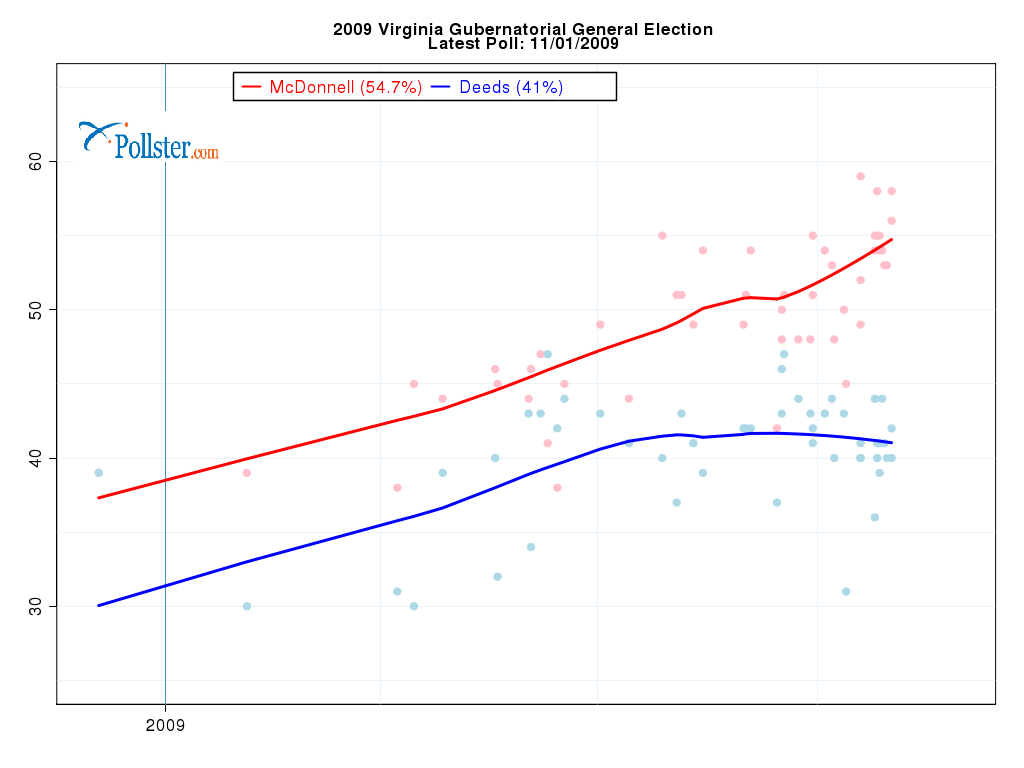
But does this current polling actually tell us anything about what will happen on election day? Not really. At this point in 2009, all but one scientific poll had eventual winner and current Republican Governor Bob McDonnell winning by 9pt or less. A few polls even had Democrat Creigh Deeds ahead by mid-June, but most had McDonnell ahead by about 5pt. With a few exceptions – notably from SurveyUSA, which consistently showed double-digit McDonnell leads by early August – most surveys continued to show a single-digit McDonnell lead through September. McDonnell won by 17pt.

You think that’s unusual? Go back to the 2005. Through this point in the campaign, not a single poll had the eventual winner, Democrat Tim Kaine, ahead. A few polls had him down as much as 10pt, while the majority had him behind by mid-to-high single digits. Republican Jerry Kilgore trailed in only one public poll, all the way through early October! Tim Kaine, of course, went on to win by 6pt.

Overall, the polling at this point and through September has been off by about 10-15pt the last two elections. Given that Cuccinelli has a 4pt lead in the HuffPollster aggregate, either candidate could win. Perhaps Cuccinelli will win by a margin greater than 4pt, maybe less, maybe exactly that. Or maybe T-Mac will come out on top.

You might be tempted to look at the candidates’ favorable ratings, but I wouldn’t make too big a deal of those either, as they merely reflect the ballot standing of each man at this point. The important point is that both feature positive net favorables. Given that over 30% of voters have no opinion of Cuch, and over 40% have no opinion of T-Mac, the favorable ratings of these candidates will change. In 2005, Jerry Kilgore had a higher net favorable than Tim Kaine, which could be seen in the ballot test. He ended the election with a lower net favorable rating and lost. In 2009, Bob McDonnell had a net favorable rating equal to Creigh Deeds in early polling, which was reflected by a tight race in the ballot test. McDonnell ended up with a much higher net favorable rating, and indeed, he crushed Deeds.

What about the difference between the likely and registered voter results? The number one polling lesson from 2012 was that when likely and registered voters disagree in elections with high voter turnout, you should go with the registered voter results. Obviously, an off-year affair is not a high turnout election. Still, I was curious to see if over the past two cycles, pollsters have tightened the electorate, keeping in mind that only a few pollsters release results among both registered and likely voters, and most don’t.

Among those who report results from different screens, it’s not really clear that pollsters who use a likely voter screen are getting more accurate results than those that only polled registered voters. A 2009 October Virginia Commonwealth University poll had McDonnell winning by 18pt among likely voters and 16pt among registered voters. Neither was more accurate than the other. A 2009 October Roanoke College poll had McDonnell ahead by 17pt among likely voters and by 19pt among who said they were certain to vote (who we’ll call “definite” for the sake of clarity). In this instance, the looser screen ended up being closer to the final result.

In 2005, tightening the electorate did pollsters no favors either. An October Diageo/Hotline poll found Kaine winning by 2pt among registered voters, 1pt among likely voters, and down by 2pt among definite voters. Kaine, as mentioned, won by 6pt. An October Roanoke College poll had Kaine winning by 8pt among probable voters and 10pt among definite voters. Again the looser screen performed better than the more selective one.

What about earlier in the campaign? In 2009, an August Washington Post poll had McDonnell up by 15pt among likely voters and by 7pt among registered voters. Clearly, the likely voter result was closer to the truth – in this case, at least. In 2005, the opposite occurred. An early September Washington Post poll had Kilgore up by 7pt among likely voters and by 4pt among registered voters. Earlier in the campaign, SurveyUSA showed a dramatic rise in Kilgore’s lead from 4pt to 10pt between May and June when switching between registered and likely voters. Other polling companies showed a consistent race, which means that the far less accurate June result was almost certainly because of a change in the electorate being polled.

Thus, I’m not really sure there’s much to take from the recent polling data on the Virginia gubernatorial race. Yes, Ken Cuccinelli likely has a small lead at the moment, but that edge probably means very little. The difference between the registered and likely voter screen may be instructive, but we can’t yet be sure when to trust it. Tighter voter screens have not proven to necessarily be more accurate in either the 2005 or 2009 Virginia gubernatorial elections.

We can only sit back and allow the campaign to unfold.

• A previous version of this article incorrectly stated the leader of The Washington Post’s survey of the Virginia gubernatorial race and has been corrected accordingly

guardian.co.uk © 2013 Guardian News and Media Limited or its affiliated companies. All rights reserved. | Use of this content is subject to our Terms & Conditions | More Feeds

Why the ‘daring’ Virginia redistricting plan may not be such a bad thing

Republicans played a dirty game, but the result is likely a Virginia Senate that better emulates statewide voting patterns

Republicans in the Virginia State Senate passed a daring redistricting plan on Monday. I say “daring” because the only way Republicans were able to get the bill through the evenly divided senate was to bring it up for a vote when a Democratic member was at President Obama’s inauguration. Democrats are rightly infuriated, but is the result really so terrible for the people of Virginia?

First off, I think we can all admit it’s bad PR to jam a bill through when a member is gone. To make matters worse, the missing Democratic member was a civil rights leader attending the inauguration of the first black president. That’s why you had both the Republican Governor Bob McDonnell and Lieutenant Governor Bill Bolling coming out against the redistricting plan.

Any good Democrat will also say the people elected a 20-20 split, and yesterday only 39 members were present. Republicans decided not to play by the rules and in doing so defied the will of the people.

On the other hand, it’s not like the Democrats haven’t played a similar redistricting game before. Eleven Texas Senate Democrats actually left the state in 2003 to prevent a mid-decade redistricting, which is unusual in that redistricting usually, though not always, takes place in the beginning of the decade after the census. There’s nothing wrong with mid-decade redistricting, yet Democrats departed to avoid a quorum call because without the Democratic members there weren’t enough senators to actually conduct Senate business. Eventually, a quorum did take place and Republicans got their redistricting.

The Supreme Court ruled that the Texas redistricting was legal with one minor Voting Rights Act (VRA) exception, and I’m guessing that the Virginia plan is too. Diluting minority voting power, which is a violation of the VRA, is usually the pitfall of many redistricting plans. As Kenton Ngo pointed out on Twitter, “If VA Republicans were smart enough not to touch the already cleared [Voting Rights Act] districts, the plan will likely stand. Dems are toast.” Not only did Republicans not take away any black majority seats, but part of their gerrymander was to actually create another black majority seat. That’s to say they concentrated black Democratic strength into one district to get a black senator, which ensures that majority white districts become more Republican.

If the Republican plot was politics as usual, will it create a senate that doesn’t reflect the majority of Virginia voters? In other words, will Republicans be getting more seats than they deserve given the statewide vote for senate? Republicans were able to pick up about 10 more seats in the United States House of Representatives in 2012 because Republicans controlled redistricting in a lot of states. This redistricting, along with natural Democratic concentration in the cities, helped Republicans maintain a 33-seat majority even when losing the nationwide vote for the house by a point.

The old Virginia Senate districts were drawn by Democrats in 2011 in an effort to try and maintain their then four seat majority. Republicans were up in arms and for good reason. Republicans were only able to win 20 out of 40 seats in 2011, despite the fact that they won the statewide vote for senate 57% to 40% in the 2011 elections. That result is far more skewed than it was for the national house in 2012. If percentage of vote equaled percentage of seats, Virginia Republicans should have won 23 to 24 seats in 2011. Usually, though, in single member districts, the curve is more responsive and 57% of the vote would result in something like 60-65% or 24 to 26 of the 40 seats.

The new districts are more likely to mirror the statewide vote for state senate. One estimate from Ben Tribbett has Republicans winning up to 27 seats in a good Republican year. This isn’t terribly far off from the upper range of the responsive curve for the 2011 elections, and it certainly is closer to statewide vote than the actual 2011 seat makeup. My friend Sean Trende puts the estimate at locking in a Republican majority by two to three seats. This would actually be at the lower end of the proportional curve, but still closer to what we’d expect than the actual 2011 seat makeup.

Thus, while Virginia Republicans may have done something dirty, it’s hard for me to be up in arms about it. They’ll certainly take hits for it in the press and from Democrats. At the end of the day, however, the result is likely a Virginia Senate that better emulates statewide voting patterns. And while I think they probably will, the only question left is whether or not the courts find it legal.

guardian.co.uk © 2013 Guardian News and Media Limited or its affiliated companies. All rights reserved. | Use of this content is subject to our Terms & Conditions | More Feeds

Pick your pollster and take your choice in Virginia’s gubernatorial election | Harry J Enten

Two polls both show Democrat Terry McAuliffe in a narrow lead over Republican Ken Cuccinelli, but one calls it ‘a tie’. How so?

When you think of political polls, the first thing that probably comes to mind is one candidate winning and another losing. After all, we tend to judge a pollster’s performance on whether they are right or wrong in predicting the winner. Top lines, however, don’t always tell the whole story. Never has this been clearer than in two polls released over the last two days for the Virginia gubernatorial election.

The two polls, released by Public Policy Polling (PPP) and Quinnipiac, are statistically similar at first glance. Democrat Terry McAuliffe leads Republican Ken Cuccinelli in both surveys. His advantage is 5pt per PPP and 1pt per Quinnipiac. This spread fits with the two prior polls in the race that had McAuliffe ahead by 4pt and 1pt, given the margin of error.

The correct read on this race given the four polls is one in which McAuliffe seems to be holding a slight lead, with a long way to go before election day. That, however, was not how either PPP or Quinnipiac described the race in their respective write-ups.

PPP said, “McAuliffe opens 2013 with a lead over Cuccinelli.” The release quoted president of Public Policy Polling Dean Debnam saying, “Ken Cuccinelli’s unpopularity is really the story of the race at this point.”

Quinnipiac countered PPP’s headline with “Cuccinelli, McAuliffe tied as Virginia governor race begins.” Peter A Brown, assistant director of the Quinnipiac poll, went on to note that while the “candidates for governor have run statewide previously, voter memories are short and they are little-known to Virginia voters.”

How is anyone supposed to make sense of the differences presented here? You’d think PPP and Quinnipiac were polling two different races, despite relatively similar headline figures. But if we look under the hood, it turns out that things becomes even more complicated.

The reason PPP regards Cuccinelli as unpopular is that they find he is. His net favorable (favorable minus unfavorable) is -16, with 73% of voters registering an opinion of him. PPP often finds politicians with lower favorables than other polls, but even when controlling for pollster, Cuccinelli is seemingly deeply unpopular. Of the 126 current major statewide office holders PPP has polled over the past few years, Cuccinelli would rank seventh lowest, or be in the bottom fifth percentile. Heck, he can’t even get to 50% favorability within his own party, with a favorable rating of just 48% among Republicans.

Quinnipiac, on the other hand, sees Cuccinelli as relative unknown because he is in their polling. His net favorable is +8, with only 59% of all voters holding an opinion about him. Cuccinelli also hits 64% favorability among Republicans. Part of that is question ordering, whereby Cuccinelli is identified as a Republican before favorability is asked. Still, you’d expect that ordering to drive up his unfavorables among Democrats and independents. Instead, Cuccinelli’s unfavorables are 20pt lower among both of these groups in the Quinnipiac survey.

PPP and Quinnipiac simply don’t jibe. What’s more bizarre is the rest of each of the polls tends to match up fairly well, or, if anything, would suggest that McAuliffe would do better in the Quinnipiac poll. The Quinnipiac survey, at 69%, is 4pt less “white” than PPP, which should favor the Democrat McAuliffe. The Quinnipiac universe is significantly younger, with 44% of voters under 45, compared with only 36% from PPP, which should also favor the Democrat McAuliffe. And if you’re into this sort of thing, Democrats hold a 7pt lead in self-party identification, per Quinnipiac, which is greater than the 3pt edge PPP finds.

What’s more, distinctions between the other possible candidates besides Cuccinelli are relatively minor in the two polls. Both have McAuliffe being unknown by 50%-plus of the electorate. His net favorable of +7 is actually higher in Quinnipiac, though that’s not surprising given that PPP generally has politicians with lower favorability overall. The possible Republican-turned-Independent candidate Bill Bolling is unknown, by an even greater number of voters. He has a net favorable of about +10 in both polls. Bolling takes about 15% of the vote in a hypothetical three-way in both surveys.

The only real difference is that PPP shows McAuliffe expanding his lead to 8pt when Bolling is included, while Quinnipiac shows it shrinking by 1pt to a tie. The explanation for this divergence is quite simple. Both Democrats and Republicans pass over their party’s candidates equally, to go to Bolling in Quinnipiac’s poll, while only Republicans leave their man, Cuccinelli, in PPP’s survey. This makes sense given that Republicans are a lot more opposed to Cuccinelli in the PPP universe.

So, we’re presented with two polls, from Quinnipiac and Public Policy Polling, for the same race that are the same on top, but different inside. I throw up my hands in puzzlement for why this is. All I can say is that Democrat Terry McAuliffe is a relative unknown and has a small lead in the Virginia gubernatorial election. Republican Ken Cuccinelli’s high net unfavorability per PPP, and decently high net favorable rating per Quinnipiac, simply can’t be explained – beyond saying it’s statistical noise.

guardian.co.uk © 2013 Guardian News and Media Limited or its affiliated companies. All rights reserved. | Use of this content is subject to our Terms & Conditions | More Feeds

What early polling can – and can’t – tell us about 2013′s key US elections | Harry J Enten

In races like the New York mayoral election, most candidates’ lack of name recognition makes early polling highly unreliable

Polls taken early in the election season are a most interesting phenomenon. The media loves them, while some think they are a waste of time.

The record shows that early surveys can tell us a lot about where a race will end up in the case of midterm House and even Senate elections. But in the 2013 elections, early polling is, at best, a very rough guide, and at worst, can tell us absolutely nothing.

Let’s take a look at the history of polls from early to late in the campaign for past contests in the races being held this year. The Massachusetts special election upcoming later this year may or may not feature Republican Scott Brown. The polls at this point have him ahead of almost all his opponents, except for, perhaps, Governor Deval Patrick.

The issue here is that none of his opponents is really well-known, which is why I wouldn’t dismiss any of them at this point. The plurality of voters have not formed an opinion on possible Democratic candidates like Mike Capuano, Ed Markey, or Stephen Lynch. The same holds true for possible Republican candidate Bill Weld.

As for the history, at this point in the 2010 Massachusetts special Senate election, Scott Brown was down 30pt to eventual Democratic nominee Martha Coakley. In fact, he was still down by 30pt with only two months to go. Yet he went on to win by 5pt.

Some might say 2010 was an exception, but just look at another special election, a year later, for West Virginia governor. The only pre-primary poll in that race had eventual Democratic candidate Earl Ray Tomblin ahead of Republican candidate Bill Maloney by 33pt. Tomblin would only retain the governor’s mansion for the Democrats by a little less than 3pt.

The bottom line is special elections can turn on a dime, especially when name recognition is low.

Another place where name recognition may be affecting early polling is in New Jersey. I already discussed how current polls that show Chris Christie well ahead of his Democratic opponents are likely inflated by a post-Sandy bounce. One would expect that his approval rating will eventually fall back to a still impressive mid 50s level.

That’s exactly where polls put another incumbent Republican Christine Whitman in 1997. Whitman led then relatively unknown state senator Jim McGreevy by about 15pt in early data. Whitman’s approval rating and polling lead held into the final month; but then, McGreevy rapidly closed the gap and only lost by 1pt.

Pre-Sandy polls put Christie ahead of declared Democrat Barbara Buono by a similar 16pt. Christie actually led by only 6pt over possible Democratic candidate Richard Codey. Christie is, no doubt, the favorite, but New Jersey is a Democratic state – and the last Republican with a good lead nearly lost.

Right next door to New Jersey is the New York City mayoral race. Early surveys have the probable Republican candidates down by 50pt to a generic Democrat in this Democratic bastion. Maybe that will hold, but I’m betting it won’t.

You don’t really have to look far to understand that polling in New York City mayoral elections is about as reliable as the subway after midnight. They were well off in 2009 and that was not an anomaly.

Polls had Democrat David Dinkins ahead of Republican Rudy Giuliani by 20pt two months out in 1989, and by 14pt in the closing weeks. Dinkins won by 2pt.

Republican Mike Bloomberg overcame an early 40pt deficit because of the 9/11 attacks to beat Democrat Mark Green in 2001. Democrat Freddy Ferrer was ahead of Bloomberg by 8pt in March of 2005. By November of that year, surveys had Bloomberg leading by 30-40py. Bloomberg took the race by 19pt.

And, of course, we don’t even know who the Democratic nominee will be for mayor this year.

Finally, in the great Commonwealth of Virginia, early gubernatorial surveys have Democrat Terry McAuliffe barely ahead of Republican Ken Cuccinelli. As in Massachusetts, however, over 45% of voters have no opinion of either candidate. There is also talk that Republican Lt Governor Bill Bolling may run as an independent, which could really throw this race for a loop.

Early surveys in the last two Virginia gubernatorial elections were off the eventual margin by 10-15pt. In 2005, Democrat Tim Kaine trailed Republican Jerry Kilgore by 5-10pt through the summer of 2005. It was only in the final months that he pulled ahead and won by 6pt. In 2009, Republican Bob McDonnell was ahead of Democrat Creigh Deeds by mid single digits through the early fall. He ended up winning by 17pt.

Thus, in the four marquee races for 2013, early polls should be taken with a big grain of salt. In all four cases, we have examples in the past 15 years of early polls being anything from 15pt to upwards of 30pt off.

That’s not to say the early polls won’t be right this time. It just means that if they are, there will definitely be some luck involved.

guardian.co.uk © 2013 Guardian News and Media Limited or its affiliated companies. All rights reserved. | Use of this content is subject to our Terms & Conditions | More Feeds