Margin of Σrror

Margin of Σrror -

Did Under Voting Cost Mount Vernon Schools the November Levy Election? (Part Two)

In my first post on under voting in Knox County, Ohio, I introduced the concept of under voting and discussed patterns of under voting in races in Knox County involving candidates. I found that the Gambier precincts exhibited levels of under voting that were below the Knox County norm in the presidential race, but that under voting rates in Gambier were much higher than the Knox County norm in other races down ballot.

This piece examines the effect of under voting on an issue race, focusing on the Knox County School Levy election that took place on November 6, 2012.

The Mount Vernon School Levy failed narrowly on November 6th, losing by a margin of 6813 votes in favor (49.3%) to 7014 votes against (50.7%). Had the levy gotten 202 more votes (a tie results in a loss), it would have passed. In the Gambier precincts, 241 votes or ~18.1% of votes cast were under votes. In the non-Gambier precincts, 390 votes or ~3.2% of all votes cast were under votes.

So, getting back to the central question, did the high rate of under voting in the Gambier precincts cost Mount Vernon Schools the November Levy Election? The answer to that question, of course, is complicated. Below, I will examine four alternative scenarios, each of which results in a slightly different answer.

Scenario One- Everyone votes, under voters all vote for the levy: This scenario, while perhaps unrealistic, is the most optimistic for the levy. Had the under voters in Gambier all voted for the levy, the levy would have passed by a margin of 7054 votes to 7014 votes (pending automatic recount). This scenario, however, is probably overly optimistic; unless the school levy could have generated the sort of enthusiasm as Barack Obama, it is at least somewhat unreasonable to expect that there would be no under votes at all in this race. It is also somewhat optimistic for the levy to assume that all under voters would vote for the levy if they had cast ballots.

Scenario Two- Everyone votes, under voters support levy at rate of voters: What if one assumes that everyone votes, but that the under voters support the levy at the same rate as those who already voted? This may be a more reasonable assumption than assuming that every under voter would naturally support the levy. In the Gambier precincts, 91.2% of voters supported the school levy. Had 91.2% of the under voters supported the school levy, the levy would have gotten approximately 220 more yes votes for a total of 7033 yes votes. However, under this assumption, approximately 21 of the under voters (~8.8%) would have voted no, giving the no side a total of 7035 no votes. Under this scenario, the levy would have failed by three (!) votes (a tie results in a loss). Obviously, the levy would have gone to recount under this scenario; the only thing that would be sure under this scenario is a lengthy legal battle.

Scenario Three- Under voting falls to norm outside Gambier, under voters support levy at rate of voters: The assumption that everyone votes is also somewhat optimistic; after all outside of the Gambier (and College Township) precincts there was some under voting in this race. If we reduce under voting in this race to the non-Gambier average of 3.2%, this means that ~43 under votes would still have been cast in this race, thus meaning that 198 fewer under votes would have been cast. By allocating these under votes in the same way as the formula in Scenario Two, 6994 total votes (increase of 181) would have been cast for the levy and 7031 votes would have been cast against the levy. As a result, the levy would have needed 38 more yes votes to pass under this scenario; however, as with the previous scenario, this result falls within the 0.5% margin to trigger an automatic recount in a local, county, or municipal election.

Scenario Four- Relaxing the Assumptions of Scenarios Two and Three: While the assumptions in Scenario One were likely too loose, the assumptions in Scenarios Two and Three may be too rigid. (Goldilocks had a similar problem with temperature and pudding!) In Scenario Two, I used the 91.2% support rate among all voters. However, it is likely that most of the under voters were Kenyon students as opposed to year-round Gambier townspeople (who make up a small portion of the Gambier vote). I also suspect that Kenyon-affiliated people may have supported the levy at a slightly higher rate than the year-round Gambier townspeople (although support must have been widespread in the village among all residents for the levy to get 91.2% of the vote). Therefore, I average Scenario 1 and Scenario 2 and say that 95.6% of under voters would support the levy.

Let me also relax the assumption of under voting- what if under voting in Gambier took place at a rate of 1.6% in the school levy election, half the 3.2% average for non-Gambier precincts? After all, the Gambier precincts showed in the presidential race that their voters are quite adept at filling out ballots when they want to make their voices heard. Is this assumption reasonable? Perhaps.

Under the relaxed assumption about under voting, ~220 under voters would be converted into voters. Using the assumption of 95.6% support for the levy, I find that supporters would gain ~210 votes and opponents would gain ~10 votes. As a result, the levy would have received 7023 votes in favor and 7024 against, failing by only two (!) votes (again, tie=loss). Once again, the election would have been decided by a recount.

So did under voting cost Mount Vernon Schools the November 2012 election? The answer to that question is a definitive “maybe.” That all depends on a.) which of the above scenarios one finds most convincing and b.) what one assumes would have happened in a recount.

The only other conclusion that can draw is that, had a lower rate of under voting taken place, the election administrator’s prayer most certainly would not have been answered. Most likely a lengthy recount process would have taken place that may have dragged on for weeks if not months.


Patterns of Under Voting in Gambier and the rest of Knox County, Ohio (Part One)

Among residents of Knox County, Ohio, the political differences between Gambier (home of Kenyon College) and the rest of the county are well-known. Gambier is populated by generally liberal students and faculty who (mostly) vote Democratic; Michelle Obama even visited the Kenyon campus in 2012. In contrast, the rest of the county is largely filled with generally conservative voters who tend to vote Republican. Indeed, 2012 Republican candidate Mitt Romney held a campaign event at the Ariel Corporation in Mount Vernon. Overall, Knox County voted for Governor Romney over President Obama by a 61 to 37 percent margin. Outside of Gambier and surrounding College Township, President Obama won the most votes in only one precinct (there was a tie in another precinct).

Using precinct-level data from the Knox County Board of Elections, this post focuses on another noticeable difference in voting patterns that exists between Gambier and the rest of Knox County: the extent to which “under voting” takes place in various contests. According to Wikipedia, an “under vote” occurs when, “the number of choices selected by a voter in a contest is less than the maximum number allowed for that contest or when no selection is made for a single choice contest.”

A close look at the Knox County Board of Elections website reveals an interesting pattern when one examines under voting by precinct. In the 2012 presidential race, not a single “presidential under vote” was cast in either Gambier precinct (the surrounding College Township precinct also saw no under votes). What makes this so interesting? In the rest of the county every other precinct had at least one under vote in the race for president.  Indeed, 213 votes (~0.8% of all votes cast) in the rest of the county were under votes.

What makes this pattern even more remarkable is that it begins to reverse itself in other races down ballot. Outside of the race for president, the under vote rate in Gambier exceeded the norm for the rest of the county.

For example:

  • In the Senate Race between Senator Sherrod Brown (D) and State Treasurer Josh Mandel (R), there were 87 under votes in Gambier or ~6.5% of all votes cast. Outside of the Gambier precincts, there were 619 under votes or ~2.3% of all votes cast.
  • In the House Race between Representative Bob Gibbs (R) and Challenger Joyce Healy-Abrams, there were 140 under votes in Gambier or ~10.5% of all votes cast. Outside of the Gambier precincts, there were 1360 under votes or ~5% of all votes cast. This despite the fact that the only debate between Gibbs and Healy-Abrams was actually held at Kenyon College in Gambier!
  • In the “Nonpartisan” State Supreme Court Race between Incumbent Robert Cupp (“R”) and Challenger Bill O’Neill (“D”), there were 730 under votes or ~54.8% (!) of all votes cast. Outside of the Gambier precincts, there were 6453 under votes or ~23.6% of all votes cast. (Note: I called this race “nonpartisan” due to the fact that, although no partisan labels appear on ballots, candidates are nominated through partisan primaries.)
  • The pattern is similar in other races down ballot.

So what implications can be drawn from this?

Here are three initial takeaways:

  • The Power of the Obama Campaign: Young voters really connected with President Obama and his campaign did a great job of reaching out to these voters and getting them to turn out to the polls. These voters were excited to vote for President Obama and filled out their ballots in such a way as to act on this excitement. This excitement about voting for President Obama, however, did not represent increased loyalty to the Democratic Party as a whole; this was made clear in the 2010 midterms as turnout among young voters remained relatively constant with historical patterns and did not experience any noticeable surge.
  • Importance of Partisan Cues: The substantial drop off that took place in the Gambier precincts for the State Supreme Court race underscores the odd things that can happen in ostensibly non-partisan judicial races. While some Kenyon students were willing to vote for a candidate with a “D” next to their name, they weren’t about to go searching for the partisan affiliation of a non-partisan candidate. (Good work on non-partisan judicial elections is being done by University of Pittsburgh Professor Chris Bonneau and UNC Graduate Student John Lappie.)
  • Under voting isn’t a liberal thing, it’s a college student thing: While under voting rates were above average in the Gambier precincts, this was not the case in the College Township Precinct. Home to some Kenyon employees, College Township has an ever-so-slight Democratic tilt. Furthermore, under voting in College Township was in line with the rates for the rest of the county. For example, 5 voters or ~2.2% under voted in the U.S. Senate race between Senator Brown and State Treasurer Mandel in College Township.

These implications are certainly not the only ones that can (or should) be drawn from this data. Indeed, the next post in this series will examine the practical implications of under voting for low turnout races, focusing specifically on the Mount Vernon School Levy.

Americans Secretly Oppose Gay Marriage

If you’ve struggled to find humor in politics recently, rejoice. At least the skewed-polls people are still around.

gaydensity

Yesterday, Chris Stirewalt blogged for Fox News that polls overstate support for gay marriage. Voicing a similar belief, leading social conservative Gary Bauer showed little concern over public opinion, telling Fox’s Chris Wallace:

“No, I’m not worried about it because the polls are skewed, Chris. Just this past November, four states, very liberal states, voted on this issue. And my side lost all four of those votes. But my side had 45, 46 percent of the vote in all four of those liberal states.”

As with many fallacies, there’s an iota of truth here. Stirewalt draws on work by New York University political scientist Patrick Egan that shows that late-season polls typically overestimate support for gay marriage compared with the election returns.

I don’t really have a problem so far. A Pollster article by Harry back in 2009 made a similar point and explored some ways to improve predictive models. The gap between pre-election polls and election returns, in other words, is well documented.

So, the polls are skewed…

Here’s where I depart from most interpretations of this observation. The poll-vote gap does not necessarily imply that the polls are “skewed.” Could it? Yes. But it doesn’t need to. I suspect a good bit of the bias comes from who votes not how they vote.

Stirewalt argues that the polls are skewed and mainly blames social desirability bias. In this line of reasoning,  respondents do not want to admit opposition to gay rights for fear of social judgement; instead, they act supportive but cast their secret ballot against. In other words, the “true” level of support is systematically lower than the polls show.

What’s crazy to me is that Stirewalt, even after basing his entire argument on Egan’s research, ignores the part where Egan dismisses social desirability as the primary cause of the polls’ inaccuracy. And Egan couldn’t be much plainer about it: “On the whole, these analyses fail to pin the blame for the inaccuracy of polling on same‐sex marriage bans on social desirability bias” (p. 7)1.

What seems most likely is that pollsters haven’t figured out how to calibrate their samples to match the turnout. Ballot measures only attract at least moderately engaged observers. On an issue like gay marriage, it’s not surprising that some who ostensibly support gay rights aren’t nearly as motivated as those who have social, cultural or religious objections to it. The polls may decently represent the “true” proportion of citizens who support gay marriage, but not the class of voters who cast a ballot on the issue.

We’re Missing the Point

But far, far more importantly, any potential skew in the polls misses the true point here. Let’s assume that the polls are skewed, and that “true” support for gay marriage is actually seven points (best guess from the Egan research) lower than the polls say.

So what?

gaytherm

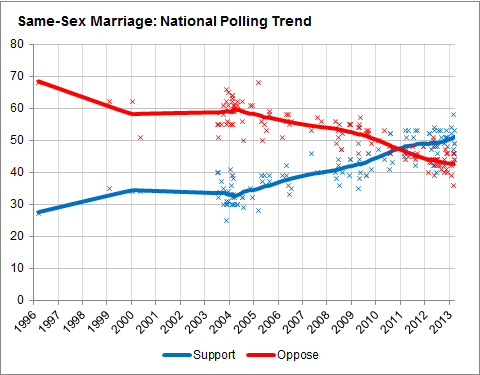
Those who invoke public opinion aren’t really that worried about crossing 50 percent. Even if the polls exaggerate support for gay marriage, the trend favors the equal rights argument. The above figure2 shows general sentiment (“thermometer” scores) toward gays and lesbians in the American National Election Study3This figure by Nate Silver shows a similar rise in support for gay marriage. And this figure from Gallup shows a widening gap favoring general rights for gays and lesbians.

In this light, even yelling “Skewed Polling!” doesn’t change the fact that support for gays and their ability to marry is rising steadily.
blackdensityNow I know that race and sexual orientation are not the same, but there are some similarities between the above kernel density plot and the one at the top of the post. In general, support for rights and general sentiment co-evolve. Sentiment toward black Americans has increased even in the post-Civil Rights era. We see a smaller but similar “swell” in sentiment for homosexuals, with every reason to think it will continue on its current trajectory.

Even if support today is really say, 51 percent instead of 58 percent, it’s much higher than it used to be.

Could we just be getting more politically correct, instead of more ‘liberal’, on gay rights? Sure, but the green line in the time series doesn’t show any real change in the rate of respondents opting out. No, young people are coming of age with a more permissive view on this issue.

Skew or no, the trend speaks for itself.

Notes:
[1] Now, as a brief aside, Egan’s first test for social desirability bias makes no sense to me. I can imagine plenty of reasons why a state’s gay population wouldn’t predict the poll-election gap. But the second test is much stronger: despite the social acceptance of LGBTs growing, the gap has become smaller. All in all, I’m sure social desirability is part of the story, but it’s most likely not the primary factor.

[2] The figure shows thermometers scaled on the interval [0, 1], as well as the proportion of respondents who respond to gays warmly (therm > 0.5), cooly (therm < 0.5), and those who opt to not answer. Confidence bands are generated using 1,000 bootstraps from the survey margin of error. The margin around “skip” seems odd, but for convenience I’m treating “skip” as an expression of a desire to not answer, and thus as a random variable in its own right.

[3] The ANES, funded by the National Science Foundation, could be at risk thanks to recent Congressional targeting of political science. Contact your representatives in Congress because (I promise!) most scholars use the study for more consequential research than I.

Bill and Claire’s Unconstitutional Adventure

“No law, varying the compensation for the services of the Senators and Representatives, shall take effect, until an election of Representatives shall have intervened.”

-The 27th Amendment to the U.S. Constitution (1992)

Senators Bill Nelson (D-FL) and Claire McCaskill (D-MO) introduced a bill today that would force members of Congress to take pay cuts equal to the cuts affecting other government agencies under sequestration. This proposal is likely to be hugely popular with the American people. What’s the problem with this plan? It’s clearly unconstitutional, as well as simply being a bad idea.

The 27th Amendment to the U.S. Constitution (posted above) makes it unconstitutional for congressional pay to be changed until an election has taken place. While ratified in 1992, this amendment was originally proposed as part of the Bill of Rights and was supported by James Madison.

Madison supported this amendment because he did not want members to vote themselves a huge pay raise before the voters were allowed a chance to register their approval or disapproval of Congress. To quote Madison, “there is a seeming impropriety in leaving any set of men without control to put their hand into the public coffers, to take out money to put in their pockets.”

This amendment also protects members of Congress who express minority opinions on legislation or nominations. Imagine this scenario: The majority in Congress wants to pass a bill that it has the votes for, but it wants to look bipartisan in passing the bill. The speaker goes to the minority leader and says, “Have your members vote yes on my bill or we will vote to cut the pay of minority party members by half.” Seem implausible? Maybe, but the 27th Amendment is an important protection against the tyranny of the majority.

In addition to being unconstitutional, cutting the pay of members of Congress is a misplaced (albeit popular) reform. While the $174,000 salary that members of Congress receive is certainly a decent salary, it is not excessive if one considers the other potential job options for members of Congress. Who can forget the million dollars that former-Senator Jim DeMint (R-SC) has been offered to run the Heritage Foundation? Dozens of other examples exist of members getting huge pay raises to work as lobbyists or other positions in the private sector after leaving Congress.

As the old saying goes, “You get what you pay for.” If you offer second rate pay to members of Congress, you will get second rate members. (Yes, even worse than now!) In other words, there needs to be a competitive salary for members of Congress in order to maximize the probability of attracting high quality individuals to the job.

Furthermore, if the pay of members of Congress is cut too much, then serving in Congress will become even more difficult for middle and lower income Americans than it is now. Members of Congress have to maintain two residences and must have an extensive professional wardrobe (among other living expenses beyond that of the average American). This isn’t a problem if you are one of the 50 richest members of Congress, but if you are a clean energy expert/advocate,  high school teacher, or farmer/gospel music singer then a drastic pay cut might make it financially difficult to serve in Congress. At the very least, such an individual would be unable to build a financial nest egg in case of an election loss, which would disincentivize them from running in the first place.

All in all, a substantial pay cut for members of Congress would serve to make the membership of Congress even less economically representative of the country as a whole than it is now. While some people might be willing to take significant financial sacrifices to serve in Congress, enlightened statesmen will not always be at the helm.

In conclusion, even if you don’t agree that Mr. Nelson and Ms. McCaskill’s proposal is a bad idea, it is clear that it is unconstitutional. And when laws are legitimately unconstitutional, the Supreme Court has a way of striking that whole thing down.

[Note: The title of the article is a pun on the movie“Bill and Ted’s Excellent Adventure.” The final line of this piece is a (hopefully satirical) reference to Rep. Todd Akin’s disastrous comments about “legitimate rape” in the 2012 election.]

Jeb Bush in 2016? Not as Crazy as it Seems.

A few weeks ago, I argued that Sen. Marco Rubio (R-FL) was not well placed to win the Republican nomination (and especially the general election) in 2016. In the months (and years) to come, I plan to review the prospects for other potential candidates to win their party’s nomination and ultimately the White House.

This piece focuses on Jeb Bush’s chances of winning in 2016, following his recent announcement that he now opposes a path to citizenship for undocumented immigrants. I take this reversal of positions for Mr. Bush to be an indication that he is seriously considering a run for the White House in 2016.

I come to this conclusion based on the following logic: If Mr. Bush is NOT considering running, what incentive is there to come out against a legal path to citizenship at this point in time, when such an announcement could negatively affect the current effort at achieving any reform? (Remember, Mr. Bush did not come out against all immigration reform, just reform that includes a path to citizenship.) Mr. Bush’s announcement could have the effect of impeding any bill from passing. Therefore, Mr. Bush must assume that their is something to be achieved by switching positions (i.e. being better positioned to run for president in 2016.) In other words, it simply does not make sense for Mr. Bush to make such an announcement unless he is considering running for president in 2016.

In this post, I compare Mr. Bush to Mr. Rubio on each of the points I emphasized in the last article, arguing that Mr. Bush is better placed to win the nomination (and the general) in 2016 than Mr. Rubio. Then, I will discuss a final caveat that relates to Mr. Bush’s prospects in 2016.

Primaries:

1. Too liberal (on immigration)?: With his recent announcement that he opposes citizenship for undocumented immigrants, Mr. Bush has placed himself to the right of Mr. Rubio (as well as Wisconsin Rep. Paul Ryan) on this issue which is of great importance in the Iowa caucuses. Yet Mr. Bush did not rule out other legal statuses for undocumented immigrants, allowing him to pivot back to the center should he win the GOP nomination. (Whether a stance that falls short of citizenship is centrist enough for a general election is debatable.) As I discuss in a later section, Mr. Bush’s ideology is one of a mainstream conservative. With this announcement on immigration, he has moved away from the one stance he held that was a deal-breaker for many conservative caucusgoers in the Hawkeye State. Indeed, making this announcement three years before the caucuses looks more like principle than opportunism than if Bush made the announcement after a (possible) failure of the current reform effort.

2. Primary schedule: While members of the Bush family have struggled in the New Hampshire primary in the past, the South Carolina primary gave George W. Bush a needed victory over Senator John McCain (R-AZ) in 2000. The primary schedule is most favorable to Mr. Bush not due to the placement of specific contests, but rather due to the fact that he would have access to the funds needed to wage a long, drawn-out primary campaign. As the son and brother of former presidents, Mr. Bush could build a campaign apparatus that could compete in every state. In the last primary campaign, one of the “non-Romney” candidates’ biggest problems was raising enough money to compete in a several month long campaign.

3. Scandal/Corruption: This category is most important to Mr. Bush in that his access to financial resources would allow him to exploit the weaknesses of his opponents, including Mr. Rubio. It was the famed Republican operative Lee Atwater who ran Mr. Bush’s father’s campaign and it is hard to forget the negative messaging that John McCain faced in the 2000 South Carolina primary. In other words, the Bushes (and their supporters) know that politics ain’t beanbag.

4. It is his (Bush’s) turn: Either a Bush or a Dole was on the ballot for the Republican Party for the president or vice president in every election from 1976 to 2004. It’s Jeb’s turn because it is (almost) always a Bush’s turn. Furthermore, in every presidential election since 1964 the Republicans have nominated someone who has run for president before, with the lone exception of 2000 when the GOP nominated George W. Bush. (Indeed, there was no viable GOP candidate in 2000 that had run for president before.)

The Republican Party is like that person who always orders the same thing every time they go to a restaurant. Republicans (particularly party elders) like orderly politics because it is, well, conservative. While George W. Bush had a less-than-ideal last few years in office, the Bush name still goes a long way with GOP primary regulars.

General Election:

5. Too conservative for the general?: Unfortunately, DW-Nominate scores do not exist for governors, so we cannot make a direct ideological comparison to Mr. Rubio, Mr. Ryan, or Mr. Paul. However, Nate Silver of the New York Times has suggested a way to calculate the ideology of governors based on issue positions listed on the website www.ontheissues.com. While admittedly a crude metric, one can use scores on individual issues on this website to calculate a rough estimate of where each governor stands and how they compare to their fellow governors, which can then be converted to a 100 point scale (where 0 is most liberal and 100 is most conservative).

Using this method, I find that Mr. Bush scores in the mid-80s (out of 100). Compared to other current or recent Republican governors, Mr. Bush is at the middle of the pack. He is certainly not as conservative as someone like Rick Scott (also of Florida) who scores a 91, but is more conservative than (former Governor) Mitch Daniels of Indiana who scores a 74.

In many ways, a good way to think about Mr. Bush ideologically is by using his brother as a proxy. In other words, Mr. Bush is a certainly a conservative, but is not completely outside the mainstream of American politics. While the country has certainly changed since 2000 and 2004, it is likely that Mr. Bush would at least be competitive in a general election. After eight years of a Democratic President, the nation may once again turn to a Bush. At the very least, Bush stands a better chance in a general election than Marco Rubio, who is clearly to the right of even most Republican politicians on most issues (not to mention the broader electorate).

Caveat:

6. Is Bush too stale? If anything holds back Mr. Bush from winning in 2016, it is more likely than not a staleness of the Bush brand and the fact that Mr. Bush has passed his (political) prime. Having left the Florida Governorship in 2007, Mr. Bush would have been out of elective office for almost a decade come 2016. This is certainly a concern and may be the biggest factor preventing a Bush candidacy. Overall, Mr. Bush stands a better chance than Mr. Rubio to win the Republican nomination and also would be in a stronger position to win a general election.

Will America elect a third Bush to the White House? With Mr. Bush’s recent switch on immigration, which indicates he may actually want to run, along with his overall strength as a candidate, such an occurrence is a real possibility.

How Senate Democrats, not just House Republicans, will block gun control | Harry J Enten

A filibuster-proof majority in Senate is already a stretch, but red state Democrats up for re-election may make it unreachable

Vice-President Biden’s group will make recommendations to President Obama this week on gun control. Majorities of Americans support numerous new gun restrictions, yet I’m pessimistic that anything will get through Congress. Why?

You might expect me to cite the Republican-controlled House, but the chances that the Democratic-controlled Senate will pass anything are not much better.

The Democrats need 60 votes to achieve “cloture” or avoid a filibuster, and that seems near-impossible. Assuming all 55 Democrats vote for a piece of gun control legislation, another five Republicans must join the coalition. I can only think of four Republicans who are gettable.

Mark Kirk, from blue state Illinois, has a lifetime F-rating from the NRA and has voiced support for an assault weapons ban. Susan Collins, from Obama-voting Maine, and Dan Coats of Indiana have each received a C+ from the NRA, and worse grades from the Gun Owners of America. Finally, John McCain of Arizona only has a B+ from the NRA and a C- from the Gun Owners.

These four Republicans, plus all the Democrats, equal only 59, which, of course, isn’t 60. Every other Republican has at least an A from either the NRA or the Gun Owners. There would have to be a major change of heart from at least one Republican in order to avoid a filibuster or make cloture.

But even if you got that magical one Republican, the openness to discuss gun control from West Virginia Senator Joe Manchin, isn’t likely to be shared by six red state Democrats who are set to run for re-election in 2014.

The reason is that regardless of how Americans view gun control right now, research indicates that they are likely to be at least somewhat affected by cues from their party leaders. This is especially the case if the party is out of power, as the Republicans currently are. You saw this during healthcare reform debate of 2009 when most Americans were in favor of Obamacare at first, then turned against it once it became a partisan issue and Republican leaders resisted the reforms. Americans then opposed the new law even as they still supported most of the policies contained within it. A similar outcome is possible this time, as Republicans leaders have not indicated much of any movement on gun control.

Pew Research found that Americans who prioritize gun rights over gun control, as well as gun owners, are more likely to say that the Republican party does a better job of reflecting their views on gun control, by margins of 44 percentage points and 22pt, respectively. Americans against gun control are more likely to be politically active than their pro-control counterparts: they are 17pt more likely to to contribute money, contact a public official, sign a petition, or express an opinion on a social network. I can’t imagine a senator from a red state, especially one in which there are more guns per household than the national average, wanting to go up against a barrage from pro-gun forces.

That’s why Max Baucus of Montana, Mark Begich of Alaska, and Tim Johnson of South Dakota all have A ratings from the NRA. They all come from states ranked third or fourth in gun ownership – at least 57% of households have a gun in the home. Baucus voted against a renewal of the assault weapons ban in 2004; Begich said he’d vote against it even after Newtown; and Johnson has seen his NRA grade go from a C+ in 2003 to an A, with an NRA endorsement, during his 2008 re-election fight.

The electoral prospects for each man adds to the unlikelihood that any will cast a vote in favor of serious gun control legislation. According to Public Policy Polling (PPP), Baucus has a net approval rating of -3pt and leads a generic Republican candidate by only 3pt. Begich won election 2008 by only 1pt and is rated as “vulnerable” by the Cook Political Report, which also pegs Johnson as the incumbent most likely to lose in 2014.

Mary Landrieu of Louisiana, too, is likely a goner on serious gun control legislation, despite a C from the NRA. She voted against renewing the assault weapons ban in 2004, and pretty much every other gun control measure of the past eight years. She won re-election in 2008 by six points – against a relatively weak opponent and in a state that voted for Romney by 17pt. She is “at risk” per the Cook Political Report. In Louisiana, 44% of households have a gun, 14th most in the nation.

Only Kay Hagan of North Carolina and Mark Pryor of Arkansas could go in favor of gun control. Hagan has an F from NRA, though she voted in favor in loosening regulations across state lines and calls herself a strong supporter of the second amendment. Pryor has a C-. He also voted to renew the assault weapons ban in 2004, and has wavered only occasionally since.

Again, the issue is that the Cook Political Report puts both of them at risk, come election season. Hagan’s net approval rating of -2 per PPP means she can’t afford to lose many voters, even if her state ranks only 23rd in the nation for households with guns, at 41%.

Pryor might be in an even worse spot. In 2012, Obama lost Arkansas by 24pt, and Democrats lost their control of the state legislature for the first time since Reconstruction. Democrats had three of the state’s four representatives in Congress during Pryor’s last election, but don’t have a single one now. He simply doesn’t need enemies in a state where 55% of households have a gun – sixth most in the nation.

So, I don’t think you can count on any red state Senate Democrat who is running in 2014. Taking away these six leaves the pro-control caucus with 53 votes in the Senate, at most – even with the four Republicans. Counting Hagan and Pryor only leaves the pro-control caucus with 55 votes.

Let’s also be real here. Joe Manchin has only said that “everything should be on the table”. He hasn’t actually committed to anything concrete. Neither have Joe Donnelly of Indiana, Heidi Heitkamp of North Dakota, nor Jon Tester of Montana – all red state Democratic senators given A-ratings by the NRA – committed to anything specific.

That’s why the smart analysis says that the chances of Congress passing serious gun control legislation decrease by the day. The House is a foregone conclusion. When all these numbers start getting added together, I’m not even sure you can find a simple majority of senators to agree on tougher gun control. A filibuster-proof majority, meanwhile, is likely impossible.

guardian.co.uk © 2013 Guardian News and Media Limited or its affiliated companies. All rights reserved. | Use of this content is subject to our Terms & Conditions | More Feeds